


The figures offer important context for current and prospective applicants, particularly in understanding realistic processing expectations.
Current Subclass 188 Applications on Hand
According to the information released by the Department of Home Affairs:
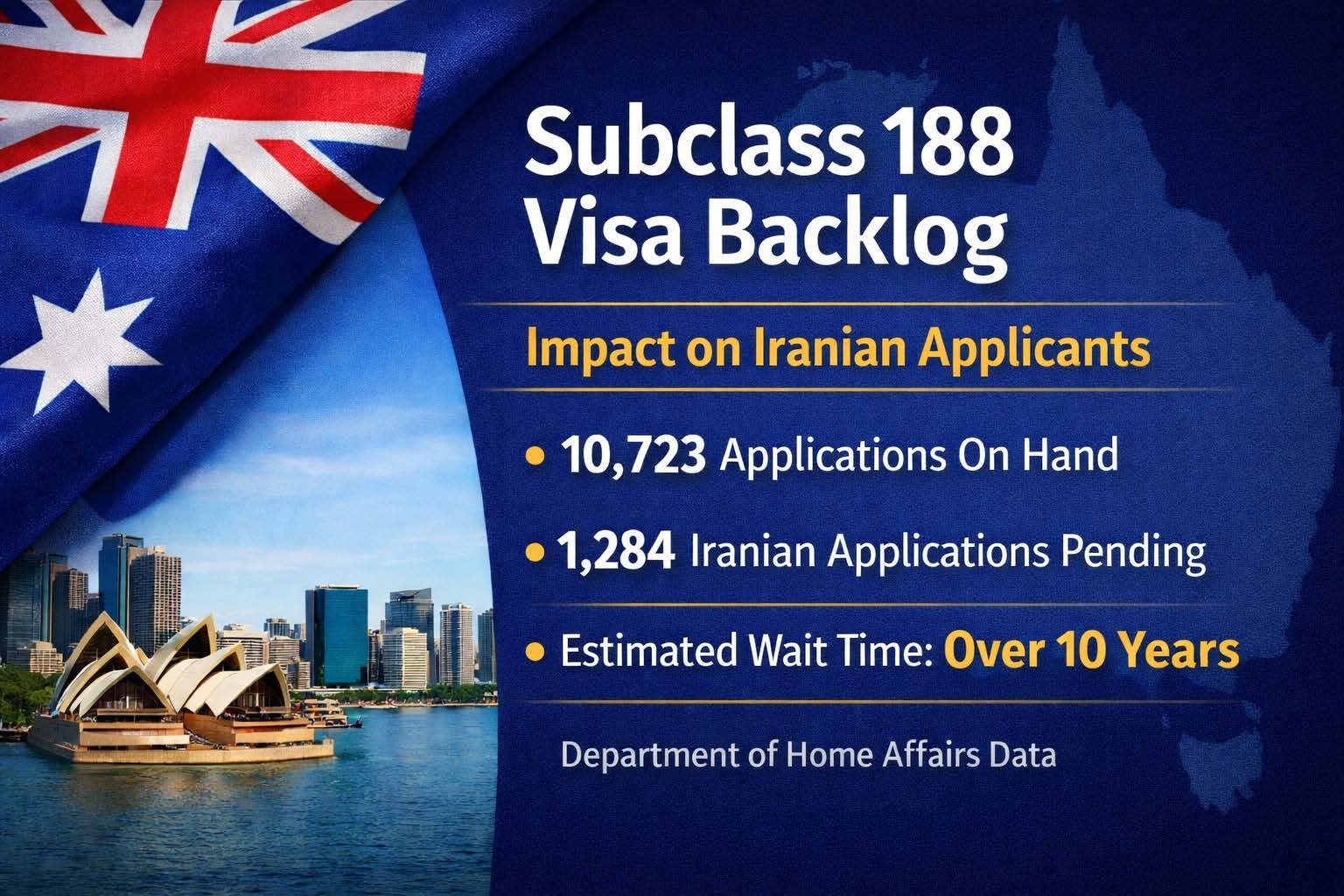
- Total Subclass 188 applications on hand (all nationalities): 10,723
- Total Subclass 188 applications on hand for Iranian nationals: 1,284
These figures include both primary and secondary applicants and represent the total number of applications held by the Department at a specific point in time, regardless of their stage of processing or assessment
Iranian nationals currently account for approximately 12 per cent of all Subclass 188 applications on hand.
Understanding the Annual Intake: A Critical Clarification
A common source of confusion among applicants is the meaning of the annual intake figure allocated to a visa subclass.
It is important to clarify that:
Australia’s migration program intake is counted per person, not per application.
This means that:
-
The primary applicant uses one program place, and
-
Each secondary applicant (such as a spouse or dependent child) also uses a separate place.
As Subclass 188 is a family-inclusive visa, a single application often consumes multiple program places.
What a 1,000-Place Annual Intake Means in Practice
If the Subclass 188 program were allocated 1,000 places in the 2025–2026 program year, the practical outcome would be:
-
With an average family size of three people, only around 330 applications could be finalised per year
-
With an average family size of four people, that figure would fall to approximately 250 applications per year
This distinction is critical when assessing how long it may take for an individual visa to be granted.
Based on the Department’s figure of 10,723 applications currently on hand, and assuming:
-
An annual intake of 1,000 places
-
No increase in program allocation
-
No priority processing
-
No significant policy changes
-
No new applications entering the system
A purely mathematical assessment indicates that:
It could take well over 10 years for the existing backlog to be fully processed.
In practical terms, because each application typically includes multiple applicants, the effective number of applications finalised each year is substantially lower than the intake ceiling, meaning that grant timelines for newly lodged or recently lodged applications may extend into the next decade.
This estimate is illustrative only and does not constitute a processing guarantee.
Important Limitations of the Data
The Department of Home Affairs has confirmed that the released data:
-
Does not indicate processing stages
-
Does not show how close any application is to a decision
-
Is reported as an end-of-month snapshot
-
Is considered provisional and subject to revision
Conclusion
The official data obtained by Shada Legal demonstrates that the Subclass 188 visa program is facing a significant backlog, compounded by a limited annual intake and the family-based structure of the visa. Applicants should approach timelines with caution and seek tailored advice to understand how these systemic constraints may affect their individual circumstances.
If you wish to obtain a copy of the report , you can click here